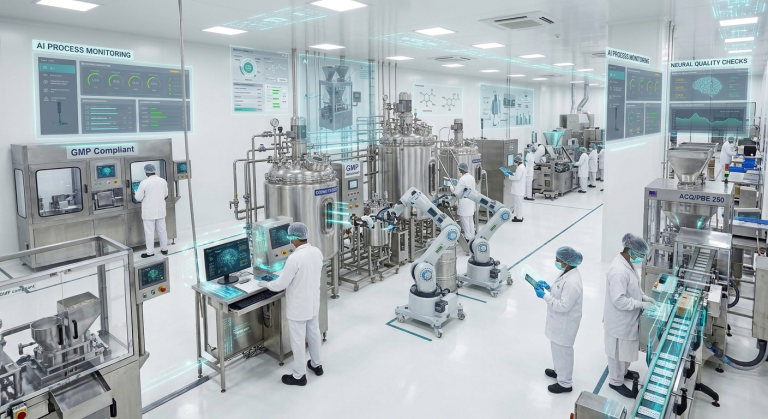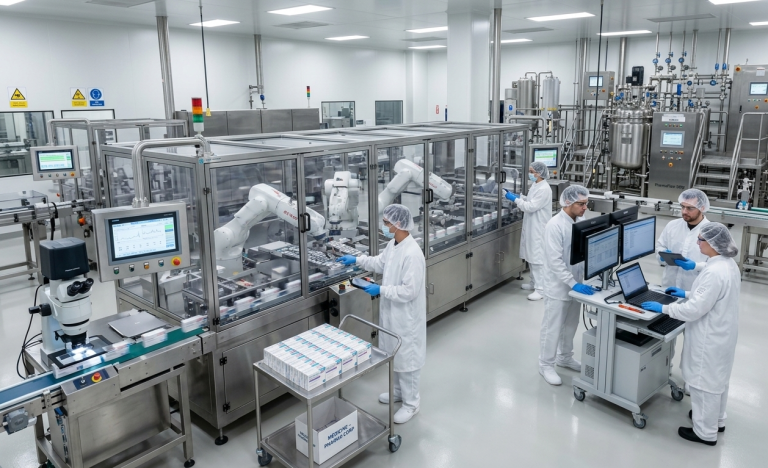
Digital Twin in Pharma, How Virtual Replicas Are Reshaping Manufacturing, Quality, and Compliance
A digital twin in pharma is a living virtual model…
Read More
Explore how Pharma 5.0 is transforming drug manufacturing through AI, smart automation, predictive analytics, digital twins, and human-centric innovation.
The pharmaceutical industry is entering a new phase of digital transformation. Artificial intelligence (AI), connected manufacturing systems, real-time analytics, and intelligent automation are changing how pharmaceutical companies develop medicines, manage production, and maintain quality. At the center of this shift is Pharma 5.0, an approach that combines advanced technology with human expertise, operational resilience, sustainability, and patient-focused manufacturing.
Unlike earlier industrial transformations that emphasized automation and efficiency, Pharma 5.0 aims to make pharmaceutical operations smarter, more adaptable, and more responsive to changing needs. It brings together AI, human decision-making, and pharmaceutical science to address persistent challenges such as production delays, quality deviations, complex regulatory requirements, and fragmented manufacturing data.
For pharmaceutical manufacturers, the opportunity is not simply to introduce AI into existing workflows. It is to build an intelligent operating environment where data supports better decisions, processes adapt to changing conditions, and quality remains central to every stage of production.
See Contents
Pharma 5.0 refers to the application of Industry 5.0 principles to pharmaceutical manufacturing and operations. It builds on the digital foundations of Industry 4.0, including automation, the Industrial Internet of Things (IIoT), cloud computing, and connected production systems.
However, Pharma 5.0 extends beyond connectivity and automated machinery. It focuses on three important principles:
AI connects these principles by helping manufacturers turn large volumes of operational data into actionable insights.
For example, a pharmaceutical plant may already use a Manufacturing Execution System (MES), Quality Management System (QMS), and Laboratory Information Management System (LIMS). Pharma 5.0 brings these systems closer together through intelligent data processing, predictive analytics, and controlled automation.
A quality manager could receive an early warning about a potential deviation, review the relevant batch history, and investigate the underlying cause before the issue affects additional batches. AI can support the investigation, while authorized personnel retain control over quality decisions.
This combination of intelligence, accountability, and human oversight is what makes Pharma 5.0 particularly relevant to regulated pharmaceutical environments.
Pharmaceutical manufacturers face growing pressure to improve productivity without compromising patient safety or compliance. At the same time, they must manage increasingly complex supply chains, changing regulations, rising development costs, and growing expectations for reliable medicine production.
The scale of the pharmaceutical industry makes these challenges significant.
The World Health Organization estimates that healthcare spending accounts for around 10% of global GDP. Better operational efficiency across healthcare and medicine supply chains therefore has broad economic implications.
The figures above provide context rather than direct measurements of Pharma 5.0 adoption. The more immediate drivers are the increasing availability of manufacturing data, advances in AI, and the need to connect digital transformation with reliable, compliant operations.
Pharma 5.0 offers a framework for bringing these priorities together instead of treating automation, quality, workforce capability, and sustainability as separate initiatives.
Explore how YuktraOS combines AI-powered intelligence, GMP compliance, and connected workflows to support smarter pharmaceutical manufacturing.
Pharma 5.0 is taking shape through the convergence of AI, connected manufacturing, digital twin in pharma, intelligent quality systems, and more flexible production models. Several developments stand out in 2026.
Traditional pharmaceutical manufacturing often relies on fixed process parameters, historical reports, and manual investigation when production deviates from expected conditions. AI introduces the ability to analyze equipment readings, environmental conditions, material properties, and process data together.
This enables manufacturers to identify patterns that may not be apparent through conventional monitoring.
AI-powered manufacturing applications include:
McKinsey’s May 2025 analysis of biopharmaceutical manufacturing found that top-performing facilities produced 17 drug-substance batches per bioreactor annually, compared with a median of 14. Closing this gap could increase output at median-performing facilities by nearly 25%. The same analysis found that only 10% of surveyed biomanufacturing plants reported using advanced analytics for regular improvement actions or real-time optimization. Source: McKinsey, Human-machine harmonization to upgrade biopharma production.
These findings highlight an important opportunity. Pharmaceutical companies may already collect significant amounts of process data, but the value comes from using that data to improve decisions and production performance.
A digital twin is a virtual representation of a physical asset, production line, or manufacturing process. It can combine equipment data, process models, and operational information to help teams understand how a system behaves under different conditions.
In Pharma 5.0, digital twins are gaining attention because pharmaceutical production requires tight control over temperature, pressure, mixing, environmental conditions, and other critical parameters.
Consider a plant preparing to introduce a new formulation. Instead of relying entirely on physical trials, engineers could use a digital process model to evaluate equipment capacity, identify possible bottlenecks, and test selected operating scenarios before making changes on the production floor.
Digital twins can support:
The goal is not to replace physical validation or required qualification activities. It is to improve preparation, reduce avoidable experimentation, and provide better information before operational decisions are made.
Grand View Research’s Pharma 5.0 market report, updated in September 2026, estimates that the global market was worth $7.9 billion in 2025 and projects it to reach $37.6 billion by 2033, representing a projected compound annual growth rate of 21.9% from 2026 to 2033. These are market-research estimates, not independently verified measurements of industry-wide implementation.
One of the most important developments in pharmaceutical technology is the move from AI that answers questions to AI systems that can coordinate defined tasks across workflows.
Agentic AI can be designed to retrieve information, compare records, identify missing documentation, route tasks, and prepare recommendations within controlled boundaries.
In pharmaceutical quality management, this could support several activities:
For example, when a production deviation is recorded, an AI agent could collect the relevant batch records, equipment history, and previous investigations. It could then prepare a structured evidence summary for the quality team.
However, an AI-generated summary is not the same as an approved investigation. Root-cause conclusions, product disposition, and other decisions requiring authorized review must remain within the organization’s established quality processes.
This distinction is especially important in GxP environments, where traceability, data integrity, and accountability matter as much as efficiency.
Equipment failure can interrupt production, delay batch release, and create additional operational costs. Predictive maintenance uses equipment data to identify signs of degradation before a failure occurs.
AI models can examine vibration, temperature, pressure, energy consumption, and maintenance history to identify abnormal patterns.
For pharmaceutical manufacturers, this can be particularly useful for equipment such as:
Imagine a filling machine showing a gradual change in vibration and operating temperature. A predictive maintenance system could flag the pattern, compare it with historical events, and recommend an inspection before the next planned production run.
The maintenance team would still assess the warning and determine the appropriate action. The benefit is earlier visibility, better planning, and fewer unexpected interruptions.
Pharmaceutical production has traditionally relied heavily on batch-based processes. Continuous manufacturing offers an alternative in which materials move through connected production stages under controlled conditions.
Pharma 5.0 can strengthen this approach by combining continuous manufacturing with real-time monitoring, process analytical technology (PAT), advanced process control, and AI-supported analysis.
This combination can help manufacturers detect process changes sooner and maintain a clearer view of production performance.
The trend is particularly relevant for organizations seeking more flexible production, improved process understanding, and reduced material waste. However, continuous manufacturing requires suitable process design, control strategies, equipment, and regulatory planning. It is not appropriate for every product or manufacturing process.
Documentation remains a significant operational burden in regulated manufacturing. Teams prepare and review standard operating procedures (SOPs), deviation reports, change controls, training records, validation documents, and audit evidence.
Generative AI can help organize information and prepare draft content using approved internal sources.
For example, an AI-powered documentation system could help a quality professional compare an SOP revision with an earlier version, identify changed requirements, and prepare a summary for review.
It could also help employees locate relevant procedures without searching through multiple document repositories.
The challenge is ensuring that generated information is accurate, traceable, and based on authorized sources. AI should not invent procedural requirements, silently alter approved documents, or bypass document-control workflows.
Pharma 5.0 therefore requires a combination of AI assistance, controlled document management, human review, and appropriate electronic records controls.
Pharmaceutical supply chains involve suppliers, manufacturers, distributors, logistics providers, and healthcare organizations. Disruptions at any point can affect medicine availability and product quality.
AI can help manufacturers combine supplier information, inventory levels, demand forecasts, transportation data, and environmental monitoring to identify potential risks.
Current applications include demand forecasting, inventory optimization, supplier risk monitoring, shipment exception detection, and cold-chain analytics.
For temperature-sensitive medicines and biologics, connected sensors can provide information about storage and transportation conditions. AI can help identify unusual patterns and alert responsible teams when predefined thresholds or risk indicators require attention.
These systems do not replace product-specific storage requirements or established excursion assessment procedures. Instead, they help teams identify issues earlier and coordinate responses more effectively.
Sustainability is another important part of Pharma 5.0. Pharmaceutical companies need to manage energy consumption, water usage, material waste, and the environmental impact of manufacturing operations.
AI and connected sensors can help identify inefficient equipment, excessive energy use, and recurring process losses. Production teams can use these insights to evaluate improvements while maintaining product quality and compliance.
The human-centric element is equally important. Pharmaceutical manufacturing depends on the expertise of operators, engineers, scientists, and quality professionals. Technology is most valuable when it reduces repetitive work, improves access to information, and helps people make better decisions.
This also means investing in workforce training. Employees need to understand how AI recommendations are generated, when outputs should be challenged, and how to report errors or unexpected behavior.
Pharma 5.0 is not simply about making a factory more automated. It is about making the factory more capable, resilient, and responsible.
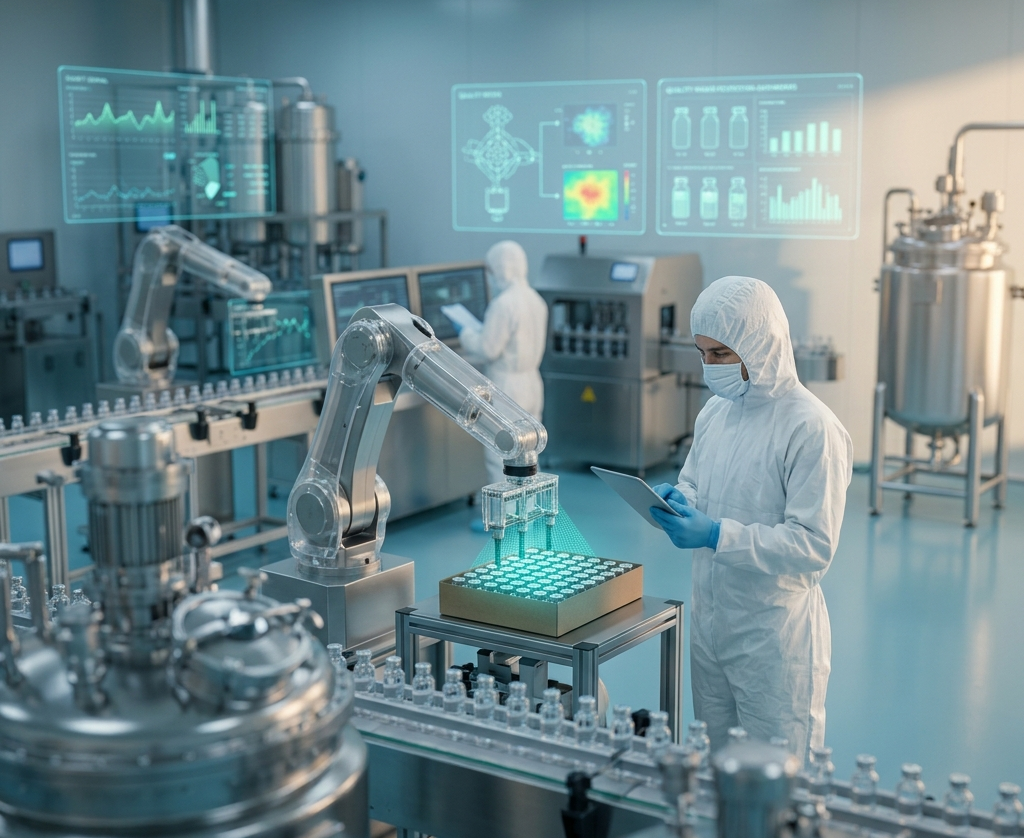
Recent research shows that the pharmaceutical industry is moving beyond experimentation toward more practical uses of AI and digital manufacturing technologies.
Here are three findings that help explain the direction of this transformation.
Grand View Research forecasts a compound annual growth rate of 21.9% between 2026 and 2033, with the market potentially reaching $37.6 billion by 2033.
PMMI’s 2026 pharmaceutical manufacturing research found that 71% of surveyed end users identified documentation and regulatory reporting as their most difficult compliance aspect.
The research was based on a survey of 87 respondents, interviews, and secondary research.
McKinsey reported that only 10% of respondents across 20 biologics drug-substance manufacturing plants used advanced analytics for regular improvement actions or real-time optimization.
Taken together, these findings point to two opportunities: pharmaceutical companies need better ways to manage compliance information, and they need to extract more value from the manufacturing data they already collect.
The statistics should be interpreted within their respective research scopes. The market forecast is an estimate, while the operational findings relate to specific survey populations rather than the entire pharmaceutical industry.
Adopting Pharma 5.0 does not require replacing every existing manufacturing system. A more practical approach is to identify operational problems, establish reliable data foundations, and introduce AI where it can provide measurable value.
Start by reviewing the systems used for production, quality management, laboratory operations, maintenance, and inventory management.
Identify where data is duplicated, where employees rely on manual reporting, and where information remains isolated in separate applications.
This assessment helps determine which processes would benefit most from better integration and intelligent analysis.
AI systems require consistent, contextualized, and trustworthy data. In pharmaceutical manufacturing, this includes batch records, equipment histories, laboratory results, approved procedures, and deviation records.
Data should have clear ownership, appropriate access controls, and traceable changes. Integration standards and interfaces should preserve the meaning and context of information as it moves between systems.
Without this foundation, even advanced AI models can produce misleading recommendations.
Rather than launching multiple AI projects simultaneously, begin with a defined problem.
Examples include reducing the time needed to retrieve audit evidence, identifying recurring deviations, predicting equipment maintenance needs, or improving production reporting.
Establish baseline measurements before implementation. Relevant indicators may include deviation investigation time, unplanned downtime, documentation review time, batch cycle time, and repeat deviation rates.
Pharmaceutical companies must assess the risks associated with each AI application.
The US Food and Drug Administration’s January 2025 draft guidance, Considerations for the Use of Artificial Intelligence to Support Regulatory Decision-Making for Drug and Biological Products, recommends a risk-based approach to establishing AI model credibility for its intended context of use.
This guidance concerns AI supporting regulatory decisions about drugs and biological products. It is not a universal validation standard for every manufacturing AI application, but its emphasis on intended use and model credibility is relevant to responsible AI adoption.
Manufacturers should also assess applicable GMP requirements, electronic records and signature controls, data integrity, cybersecurity, change management, and human oversight.
Once a pilot demonstrates value, evaluate whether the solution can be extended to other production lines, facilities, or workflows.
Track both operational improvements and quality indicators. Faster reporting is useful, for example, only if it maintains accuracy, traceability, and required review processes.
A controlled expansion strategy helps pharmaceutical companies build confidence in AI while avoiding unnecessary complexity.
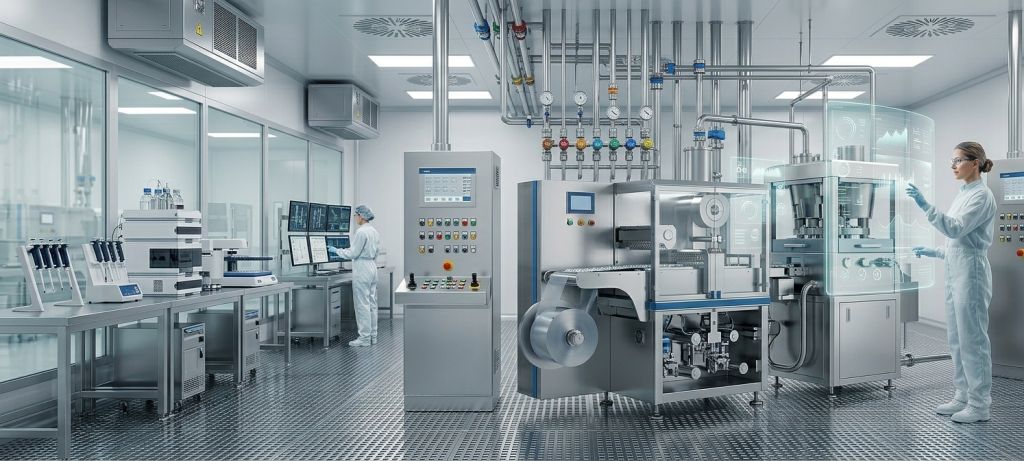
Despite its potential, Pharma 5.0 introduces challenges that manufacturers must address before scaling their investments.
These challenges explain why Pharma 5.0 requires more than purchasing AI software. It calls for coordinated investment in data architecture, process engineering, governance, cybersecurity, and employee capabilities.
The next stage of pharmaceutical manufacturing will likely involve closer connections between intelligent software, production equipment, quality systems, and human decision-making.
AI agents may increasingly coordinate routine tasks across manufacturing and quality workflows. Digital twins may support process simulation and technology transfer. Predictive models may help production teams anticipate deviations and equipment failures. Connected supply chains may provide better visibility into material availability and product conditions.
At the same time, pharmaceutical companies will need to distinguish between AI that assists employees and AI that influences regulated decisions. The latter requires particularly careful risk assessment, documented controls, and appropriate human oversight.
The strongest implementations will be those that combine technical innovation with practical manufacturing knowledge. AI must work within the realities of validated processes, product-specific requirements, and patient safety.
Connect AI, GMP compliance, and manufacturing workflows with YuktraOS to improve operational visibility, support quality management, and prepare for the next stage of pharmaceutical innovation.
Pharma 5.0 represents a shift toward pharmaceutical manufacturing that is intelligent, connected, human-centric, and resilient. Its value comes from bringing AI, automation, data integration, and human expertise together to improve production performance without compromising quality or compliance.
For pharmaceutical manufacturers, the immediate priority is to identify where intelligent technologies can address measurable operational problems. Building reliable data foundations, integrating existing systems, and establishing appropriate AI governance will be essential to long-term success.
Organizations that approach Pharma 5.0 as a business and manufacturing transformation, rather than a standalone technology project, will be better positioned to improve efficiency, strengthen quality management, and adapt to future industry demands.
The future of Pharma 5.0 will not be defined by how much AI a pharmaceutical plant uses. It will be defined by how reliably that intelligence helps people manufacture safe, high-quality medicines.