PharmaTech in 2026: Why Pharma Manufacturing Needs an AI-Powered Operating System
Discover how YuktraOS helps pharma manufacturers move beyond fragmented systems…
Read More
A digital twin in pharma is a living virtual model of a process, line or facility that mirrors real-world behavior. Learn where it delivers value, how it fits GxP, and how to build one.
Pharma leaders are under pressure from every side: tighter regulatory expectations, complex multi-site operations, rising cost of quality, and a constant need to get safe medicines to patients faster. A digital twin in pharma is emerging as one of the most practical ways to respond. Instead of learning from batch failures after they happen, teams can simulate, predict, and optimize in a virtual environment first.
This article explains what a digital twin in pharma actually is, where it creates value, how it aligns with GxP expectations, and what to consider if you plan to develop digital twin apps for your own operations.
See Contents
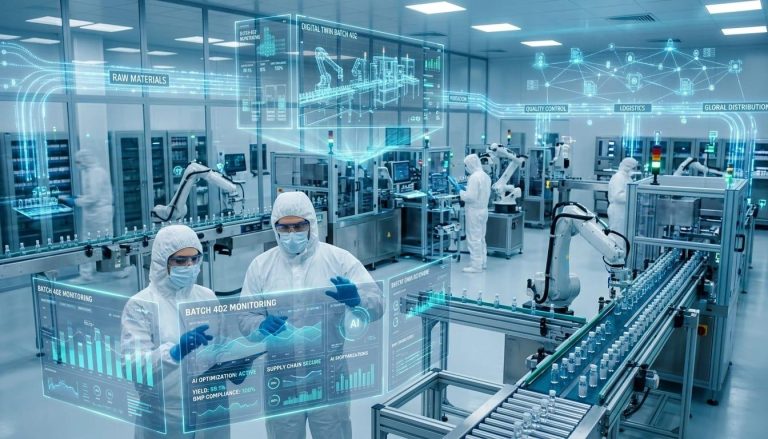
A digital twin is a dynamic virtual representation of a physical asset, process, or system. It is continuously fed with real data from equipment, sensors, laboratory systems, and enterprise platforms, so the model stays in sync with what is happening on the shop floor.
In a pharmaceutical context, the “physical” side can be a bioreactor, a tablet compression line, a cleanroom, a cold-chain route, or even an entire manufacturing network. The twin mirrors that system, lets you test “what if” scenarios safely, and flags drift long before it becomes a deviation.
This is what separates digital twin technology from a static simulation or a dashboard. A simulation answers a question once. A dashboard shows what already happened. A twin is persistent, data-connected, and predictive.
Pharmaceutical production is unusually sensitive to small variations. A minor shift in temperature, mixing speed, raw-material attribute, or hold time can affect yield and critical quality attributes. Traditional approaches rely on fixed recipes, periodic sampling, and retrospective investigation.
A digital twin in pharmaceutical manufacturing changes the operating model in four ways:
Explore how Connected Manufacturing Intelligence can drive productivity, visibility, and business growth.
Twins of unit operations help scientists understand how a process behaves at different scales. This supports Quality by Design (QbD) thinking: defining the design space, understanding critical process parameters, and reducing the number of physical experiments needed.
Instead of verifying a process only at defined points, a twin supports ongoing monitoring against expected behavior. This aligns well with lifecycle approaches to process validation and helps maintain a state of control.
By correlating in-process data with historical outcomes, a twin can estimate the likelihood of a batch meeting specification and highlight where review effort should be focused.
A twin of critical equipment can model wear, performance degradation, and calibration drift, helping planners schedule maintenance with less disruption to production.
Twins of cleanrooms, HVAC systems and utilities help teams understand how changes in pressure, airflow or occupancy may affect environmental conditions.
A virtual model of distribution routes and storage conditions helps predict excursions, evaluate alternate routing, and protect product integrity.
Operators can practice procedures, deviations, and changeovers in a virtual environment, reducing risk on live equipment.
In a regulated environment, a digital twin is only valuable if it can be trusted. That means treating it like any other computerized system that influences quality decisions. Key principles include:
Platforms built for GxP from the ground up simplify much of this work, because validation, audit trails, and access controls are part of the foundation instead of an afterthought.
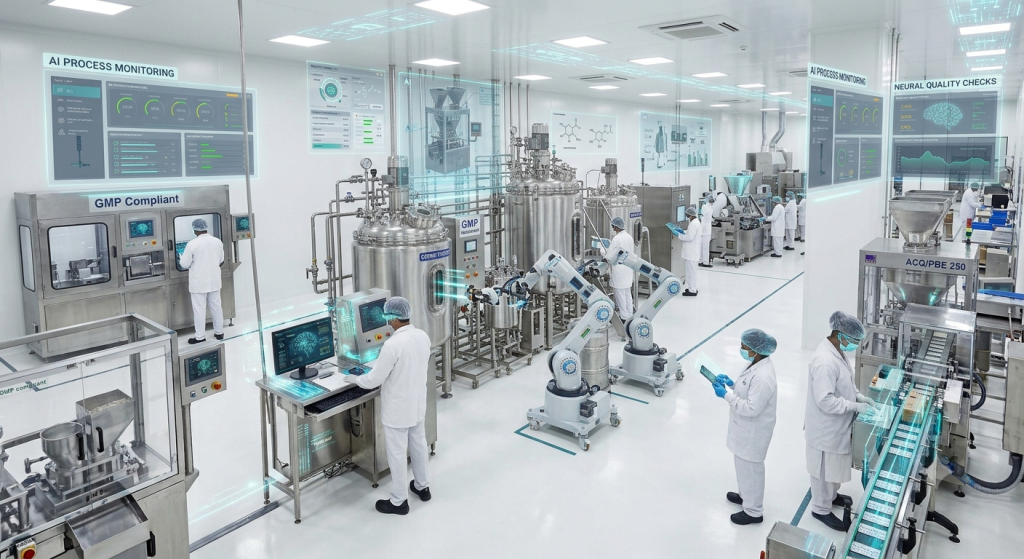
Whether you are modeling a single line or an entire network, most implementations share the same layers:
Teams that successfully develop digital twin applications tend to start small, prove value, and expand deliberately. A pragmatic path looks like this:
Start with a specific, measurable problem: reducing deviations on a particular line, improving yield on a bioprocess step, or shortening investigation time. Avoid vague goals such as “build a twin of the plant.”
Identify which data sources are needed, how reliable they are, and whether they can be accessed in near real time. Gaps in data quality are the most common reason twin projects stall.
Some processes are well understood and suit mechanistic models. Others have complex, nonlinear behavior where machine learning performs better. Many pharma use cases benefit from a hybrid of both.
Focus on one process or asset, one user group and one clear outcome. Validate the model against historical batches before exposing it to live decisions.
Involve QA and validation stakeholders early. Define intended use, risk level, data integrity controls, and documentation requirements before development accelerates.
A twin that lives in a separate tool will be ignored. Embed insights into the systems and routines people already use, such as batch review, deviation management, and shift handovers.
Once the first twin proves its value, extend to adjacent unit operations, additional sites and connected processes. Monitor model performance and retrain as conditions change.
If your organization plans to develop digital twin apps in-house or with a technology partner, keep these considerations in view:
| Challenge | Practical response |
|---|---|
| Fragmented, inconsistent data | Establish a contextualized data layer and clear data ownership before modeling |
| Regulatory uncertainty | Engage QA and regulatory early; document intended use and risk assessment |
| Low user adoption | Co-design with operators and embed outputs into existing workflows |
| Models drifting over time | Implement monitoring, scheduled review and controlled retraining |
| Pilot that never scales | Plan architecture, governance and support model for scale from the start |
AI and machine learning are making twins more adaptive. Anomaly detection, predictive models and natural-language interfaces help teams move from monitoring to proactive decision support. In a GxP setting, the differentiator isn’t just model accuracy; it’s whether AI is deployed within a governed, auditable framework, with traceability from data to decision.
This is where an AI-powered GxP platform such as Yuktra becomes relevant. By combining intelligent automation with built-in compliance controls, it gives pharma teams a foundation on which twin-driven use cases can be developed, validated, and scaled with confidence.
A digital twin in pharma is not a one-time project or a futuristic concept. It is a practical capability that helps manufacturers understand their processes better, reduce variability, accelerate decisions, and strengthen compliance. The organizations seeing the most benefit start with a focused use case, treat data and governance as first-class concerns, and build with regulated environments in mind.
If you are exploring digital twin technology for your plants, labs, or supply chain, the right starting point is a conversation about your highest-value problem and the data you already have.
Wondering where a digital twin could deliver the fastest return in your operations, or how to develop a digital twin application that stands up to GxP scrutiny? Talk to the Yuktra team to map your use case, assess data readiness, and plan a validated path from pilot to scale.
Explore how Connected Manufacturing Intelligence can drive productivity, visibility, and business growth.
What is a digital twin in pharma? A digital twin in pharma is a continuously updated virtual model of a pharmaceutical process, asset, or facility that uses real operational data to simulate, predict, and optimize performance.
How is a digital twin in pharmaceutical manufacturing different from a simulation? A simulation is typically a one-off model built to answer a specific question. A digital twin stays connected to live data, evolves with the physical system, and supports ongoing monitoring and prediction.
Is digital twin technology compatible with GxP requirements? Yes, provided it is developed and governed appropriately. This includes risk-based validation, data integrity controls, model governance, audit trails, and change control.
How long does it take to develop a digital twin application? Timelines depend on data readiness, process complexity, and validation scope. A focused minimum viable twin for a single process is a very different effort from a multi-site program, which is why starting with a clear, narrow use case is recommended.
Can we develop digital twin apps on top of existing systems like MES and LIMS? In most cases, yes. Twin applications are typically built to integrate with existing MES, LIMS, QMS, ERP, and historian systems through APIs and standard connectors, rather than replace them.
Who should be involved in a digital twin project? Manufacturing, process development, quality assurance, validation, IT/OT, and data science teams should collaborate from the start to keep the solution technically sound and inspection-ready.