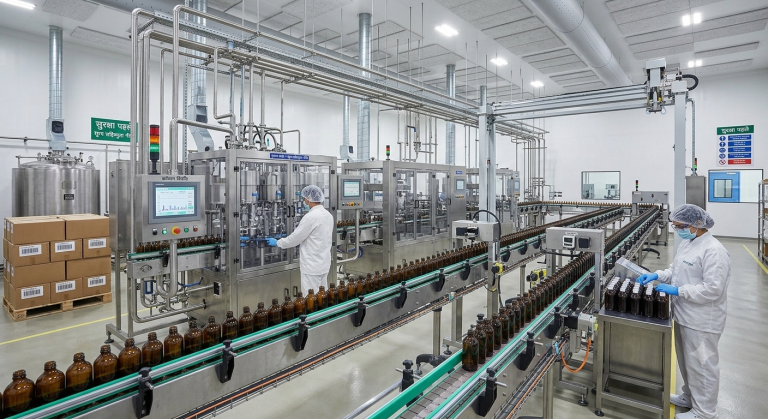
How Can AI Powered GxP Compliance Software Bridge the AI Adoption Gap?
Pharma has embraced AI in drug discovery, but manufacturing tells…
Read More
See how AI-powered GMP compliance software helps pharmaceutical manufacturers streamline quality processes, improve data visibility, and strengthen audit readiness.
Good Manufacturing Practice (GMP) compliance is not something pharmaceutical companies can treat as a once-a-year audit exercise. It is part of everyday manufacturing. From maintaining accurate records and managing deviations to controlling documents, training employees, investigating root causes, and preparing for inspections, compliance touches almost every part of a pharmaceutical operation. The challenge is that many GMP processes still depend heavily on spreadsheets, emails, paper records, disconnected software, and manual follow-ups. These methods may work when operations are small, but they become difficult to manage as manufacturing environments grow more complex. More products, more batches, more employees, more data, and tighter regulatory expectations can quickly turn compliance into a time-consuming operational burden. This is where AI-powered GMP compliance software can make a meaningful difference. Instead of simply storing compliance records, modern AI-powered platforms can connect operational data, identify patterns, help teams find information faster, support investigations, and provide better visibility into compliance risks.
For pharmaceutical manufacturers, the goal is not to replace quality teams with AI. The goal is to give those teams better information, fewer repetitive tasks, and a clearer view of what needs attention.
See Contents
Pharmaceutical manufacturing generates a large amount of information every day. Batch records, SOPs, deviations, CAPAs, laboratory results, equipment records, training records, audit observations, change controls, and production data all contribute to the overall compliance picture.
The problem is often not a lack of data. It is the difficulty of connecting and understanding that data.
A quality manager may need to review several records before understanding why a deviation occurred. A production manager may need to search through multiple systems to identify recurring issues. An auditor may ask for evidence that is stored in different locations. A compliance team may spend hours preparing reports that could otherwise be generated automatically.
Manual processes also create room for inconsistency. Information can be entered incorrectly, records can be missed, approvals can be delayed, and important follow-ups can remain buried in email threads or spreadsheets.
Built for validated environments from the ground up, not retrofitted for them.
As regulatory expectations continue to emphasize data integrity, traceability, documentation, and consistent processes, pharmaceutical companies need compliance systems that can support these requirements without adding unnecessary administrative work.
AI-powered GMP compliance software combines traditional compliance management capabilities with artificial intelligence to help pharmaceutical organizations manage quality and regulatory processes more efficiently.
Traditional GMP software typically focuses on digitizing processes such as document management, CAPA, deviation management, training, audits, and quality workflows.
An AI-powered platform can go further.
It can help teams search large volumes of compliance information using natural language, identify relationships between different records, summarize complex information, detect recurring patterns, and surface information that may require attention.
For example, instead of manually reviewing months of deviation records to identify recurring problems, a quality professional could ask the system to identify repeated deviations related to a particular machine, process, product, or production line.
The technology does not make the final quality decision. It provides context and supporting information so qualified professionals can make better-informed decisions.
That distinction is particularly important in regulated pharmaceutical environments.
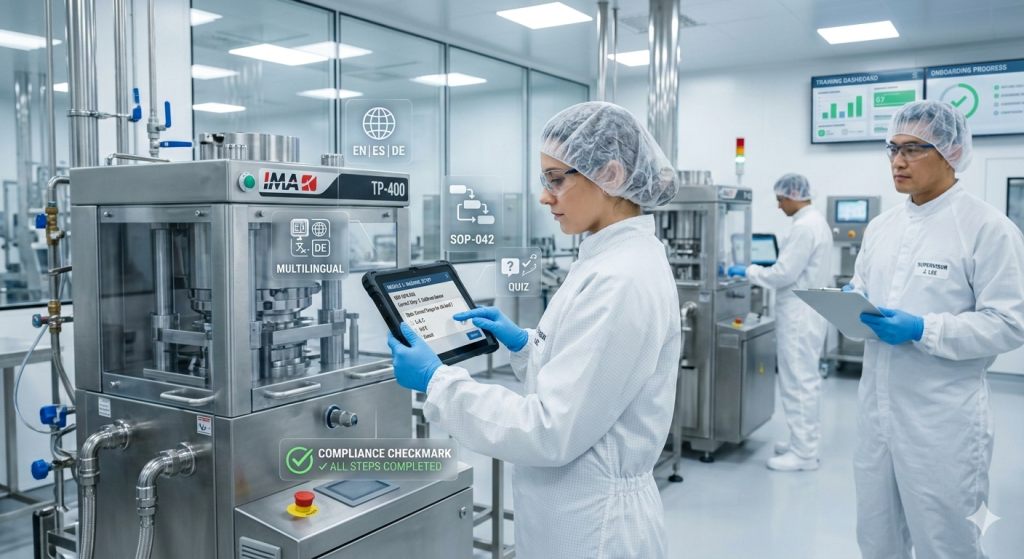
AI can support GMP compliance in several practical ways. The value comes from reducing repetitive work while improving visibility across quality and manufacturing processes.
Pharmaceutical organizations often have thousands of documents and records. Finding the right information can take time, particularly when documents are stored across different systems.
AI-powered search can allow employees to ask questions in natural language rather than relying only on file names, folders, or exact keywords.
For example, a user could ask:
“Show me the recurring deviations related to tablet compression from the last six months.”
The system can help identify relevant records and organize the information into a more usable format.
This can reduce the time spent searching for information and allow quality teams to focus more on analysis and decision-making.
Deviations are an important part of pharmaceutical quality management. However, identifying a deviation is only the beginning. Teams need to understand what happened, determine the potential impact, investigate the cause, and define appropriate corrective and preventive actions.
AI can support this process by analyzing historical deviation information and identifying similar cases.
If a particular type of deviation has appeared several times, an AI-powered system can help bring those connections to the attention of the quality team.
This can make investigations more data-driven and help organizations move beyond treating individual incidents in isolation.
Root cause analysis can become difficult when teams are dealing with large amounts of historical data.
A problem that appears to be related to equipment, for example, may actually have connections to operator training, maintenance schedules, raw materials, environmental conditions, or a change in the manufacturing process.
AI can help analyze relationships across these data points and highlight patterns that may otherwise be difficult to identify manually.
This does not mean that AI determines the root cause automatically. Instead, it provides investigators with additional evidence and context that can support their assessment.
Audit preparation can consume significant time because teams need to collect records, verify documentation, identify outstanding actions, and demonstrate that processes are being followed consistently.
An AI-powered GMP compliance software platform can provide a centralized view of compliance activities and outstanding items.
Quality teams can quickly identify open CAPAs, overdue training, unresolved deviations, pending approvals, document changes, and other areas that may require attention.
Instead of preparing for an audit only when an inspection is approaching, organizations can maintain a more continuous state of readiness.
Controlled documents are a critical part of GMP compliance. SOPs, work instructions, policies, forms, specifications, and other documents must be managed carefully.
AI can make document repositories easier to use by helping employees find relevant information quickly and understand relationships between documents.
It can also support activities such as document classification, summarization, comparison, and information retrieval.
For employees working across large manufacturing operations, this can make it easier to find the correct information without manually searching through large document libraries.
Yes, but the biggest opportunity is not simply automation.
It is reducing the amount of repetitive work that quality and manufacturing teams have to perform manually.
Consider the amount of time employees can spend searching for documents, compiling reports, reviewing historical records, following up on pending actions, preparing audit evidence, and organizing information for investigations.
These tasks are necessary, but many of them do not require employees to spend hours performing the same manual steps repeatedly.
AI can assist with information retrieval, summarization, pattern identification, classification, and workflow support.
This gives quality professionals more time to focus on activities that require experience and judgment.
For pharmaceutical organizations, that is a more practical way to think about AI. The technology is not there to remove human expertise. It is there to make that expertise more effective.

Not every digital compliance platform is suitable for a modern pharmaceutical manufacturing environment. The technology needs to support both operational requirements and regulatory expectations.
Before selecting an AI-powered GMP compliance software solution, manufacturers should consider several factors.
The platform should be designed around regulated pharmaceutical workflows rather than treating compliance as an additional feature.
It should support processes that are relevant to GMP, quality management, documentation, training, deviations, CAPA, audits, and manufacturing operations.
Data integrity is fundamental to pharmaceutical compliance.
The platform should provide appropriate controls around data creation, modification, access, traceability, and audit trails. Organizations should also evaluate how AI-generated outputs are handled and how users can verify the underlying information.
AI should support qualified employees rather than make uncontrolled decisions in regulated processes.
Users should be able to review AI-generated insights, understand the information behind them, and make the final decision where human judgment is required.
Pharmaceutical manufacturers rarely operate with a single system.
A compliance platform may need to interact with ERP, MES, QMS, LIMS, document management, laboratory, equipment, and other operational systems.
Integration capabilities therefore matter because useful AI depends on access to relevant and reliable data.
Different pharmaceutical companies have different technology environments.
Some may prefer cloud deployments, while others may require on-premises, private cloud, edge, or air-gapped environments because of operational, security, or regulatory requirements.
A flexible deployment model can make adoption easier without forcing companies to redesign their entire IT environment.
There is sometimes a concern that AI will reduce the importance of quality professionals.
In practice, the opposite can happen when AI is implemented correctly.
Quality professionals spend years developing knowledge about manufacturing processes, regulatory expectations, investigations, risk assessment, and quality systems. That expertise cannot simply be replaced by software.
What AI can change is how that expertise is applied.
Instead of spending hours looking for information, a quality professional can spend more time interpreting it. Also, instead of manually comparing dozens of records, they can review the patterns identified by the system. Instead of preparing every report from scratch, they can focus on what the information means for the business and product quality.
This moves the role of technology from record-keeping toward decision support.
Using AI in a regulated environment requires a careful approach.
Pharmaceutical organizations should not assume that an AI system is automatically suitable for GMP activities simply because it uses advanced technology.
Organizations need to understand how the system works, what data it uses, how outputs are generated, how users interact with those outputs, and what controls are in place.
AI should also operate within clearly defined governance and validation frameworks appropriate to its intended use.
The most useful approach is to introduce AI where it can provide measurable assistance while maintaining appropriate human oversight and traceability.
In other words, pharmaceutical companies should not adopt AI simply because it is available. They should adopt it where it solves a real operational or compliance problem.
Find details on AI-Powered GxP Compliance Software.
Yuktra approaches pharmaceutical compliance as an operational challenge rather than simply a documentation challenge.
The platform is designed to bring AI-powered capabilities into the systems and processes that pharmaceutical manufacturers already depend on.
Yuktra can connect the AI layer with areas such as quality management, manufacturing, laboratory operations, compliance, training, and other critical workflows. This helps organizations move toward a more connected view of their operations instead of managing each compliance activity as a separate process.
The objective is straightforward: help teams find information faster, understand operational patterns, reduce repetitive work, and stay better prepared for audits and regulatory requirements.
With capabilities across quality, compliance, training, laboratory, manufacturing, and safety workflows, Yuktra provides a foundation for bringing AI into pharmaceutical operations while keeping GMP requirements at the center.
Built for validated environments from the ground up, not retrofitted for them.
The pharmaceutical industry is moving toward more connected and data-driven operations. As manufacturing environments become more complex, simply digitizing existing paperwork may not be enough.
The next step is making operational and quality data more useful.
AI can help organizations identify patterns, connect information, automate repetitive activities, and provide faster access to insights. But successful adoption will depend on more than the AI model itself.
Pharmaceutical companies need strong data foundations, appropriate governance, secure infrastructure, validated processes, integration capabilities, and qualified human oversight.
That is why the future of GMP compliance is unlikely to be about AI replacing quality systems or quality professionals. It will be about creating smarter systems that help people manage those responsibilities more effectively.
AI-powered GMP compliance software can become an important part of that transition by bringing intelligence into everyday compliance workflows.
For pharmaceutical manufacturers, the real question is no longer whether AI can be used in GMP environments. The more important question is where AI can solve the biggest compliance and operational challenges without compromising quality, control, or accountability.
Yuktra is built around that opportunity: bringing AI, compliance, and pharmaceutical operations together in a connected environment designed for modern manufacturing.