Why Should You Implement AI in Your Pharma Plant in 2026?
earn why pharmaceutical manufacturers are choosing to implement AI in…
Read More
Pharma has embraced AI in drug discovery, but manufacturing tells a different story: only 2–3% of sites are fully digitized. Here’s why the plant floor is lagging behind the lab, and what it will take for GxP-compliant AI platforms to close the gap.
Pharmaceutical companies talk a lot about AI. Drug discovery pipelines now run on machine learning, and the industry treats it as a competitive necessity rather than an experiment. But walk onto the actual manufacturing floor, and the story changes. Batch records are still reconciled by hand. Deviation investigations still crawl through email chains. Tariff and supply chain changes still trigger manual quarterly reviews instead of automated modeling.
So is pharma rejecting AI? Not exactly. Pharma manufacturing has accepted AI conditionally, and the conditions are steep. Here’s what the data shows about why, and what needs to change.

See Contents
According to a 2026 industry analysis published by SCW.AI, only 2 to 3% of pharmaceutical manufacturing sites can currently be considered fully digitized, a figure attributed to Mike Walker, Microsoft’s Executive Director of Global Healthcare and Life Sciences Digital Strategy. That’s a striking number given how far along drug discovery has moved on the same technology curve.
Yet the upside is enormous. McKinsey’s 2025 analysis estimated that AI could unlock $60 to $110 billion in annual value for the pharmaceutical industry, as cited by digital health consultancy Eularis. A separate PwC study, referenced by SCW.AI, projected that AI driven efficiency and revenue gains could contribute over $250 billion in value within five years, with operating margins for AI forward companies potentially climbing from roughly 20% today to more than 40% by 2030. More recent tracking from Pharmaceutical Technology puts the annual value opportunity even higher, between $350 billion and $410 billion, with manufacturing and supply chain named among the functions most affected.
The incentive is not in question. The barriers are operational and structural, not a lack of belief in the technology.
Built for validated environments from the ground up, not retrofitted for them.
1. Disconnected data. MasterControl’s 2026 pharma manufacturing trends report identifies data silos as one of the most persistent obstacles. Manufacturers can’t build reliable AI systems on top of MES, LIMS, and ERP platforms that don’t talk to each other. Pharmaceutical Technology’s coverage of Hikma executive Manish Garg echoes this, naming data quality and fragmentation as a top unresolved barrier to full AI adoption.
2. The black box problem. Regulators need to understand why a system made a decision, not just what it decided. Garg’s commentary in Pharmaceutical Technology specifically flags the interpretability of AI models as a sticking point for regulatory approval, a problem that’s far more forgiving in an R&D lab than on a validated production line.
3. Talent shortage. Building and operating AI systems requires people who understand both machine learning and GxP regulated manufacturing, a rare combination. Pharmaceutical Technology cites a striking statistic: in Germany, roughly 30% of IT related positions in the pharmaceutical sector remain unfilled.
4. High upfront cost and infrastructure debt. AI in manufacturing doesn’t arrive alone. It typically requires IoT sensors, robotics, and cloud infrastructure capable of handling large data volumes, per Pharmaceutical Technology’s 2026 smart factory coverage. For manufacturers still running largely paper based or partially digitized operations, this is a capital intensive prerequisite, not an add on.
5. Fragmented ownership across the organization. Perhaps the most candid diagnosis comes from a pharma operations executive interviewed by Pharmaceutical Technology in 2026, who noted that the industry rebuilt drug discovery around AI but hasn’t shown the same appetite for operational change across a global network, leaving clinical AI, regulatory AI, and manufacturing AI as isolated efforts rather than a connected system.
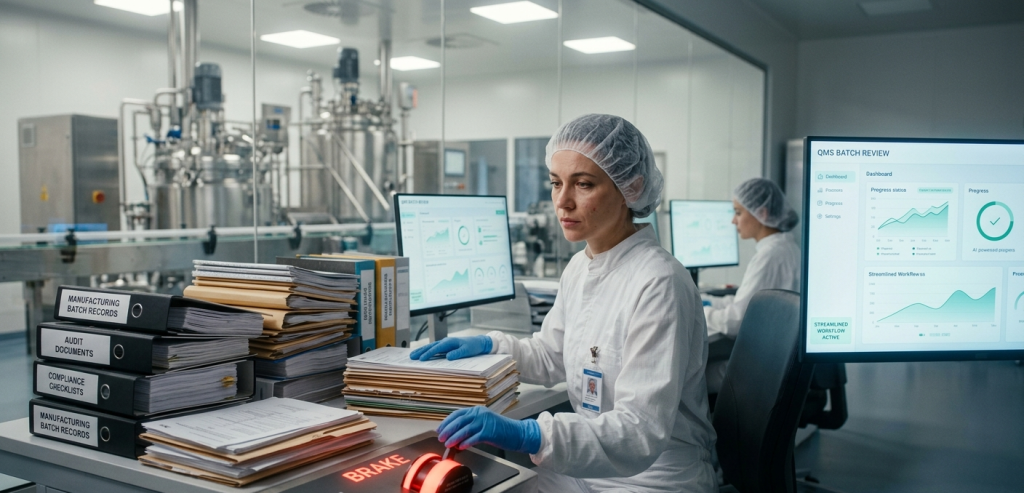
It’s not all stalled. The same Pharmaceutical Technology 2026 coverage notes that leading manufacturers have started deploying validated agentic AI that detects out of specification events, pulls relevant batch records, cross references prior deviations, and drafts root cause analysis documentation, cutting investigation time by more than 50%. Pharmaceutical Technology’s separate 2026 patent tracker also found 194 AI related pharma patent filings in a single quarter (Q3 2024), with the U.S., China, and Japan leading filings, evidence that R&D investment in operational AI is accelerating even if deployment is uneven.
The pattern that emerges: AI succeeds fastest in pharma manufacturing when it’s narrowly scoped, validated, and auditable, not when it’s a general purpose black box bolted onto a regulated process.
Given these barriers, the platforms that actually gain traction in pharma manufacturing tend to share a few traits:
Speak to Yuktra’s experts about deploying a validation-first AI platform in your existing quality and manufacturing systems.
Pharma manufacturing isn’t saying no to AI. It’s saying: prove it’s compliant, explainable, and integrated before it touches a validated process. That’s a much higher bar than most industries face, but it’s also exactly the kind of problem purpose built, GxP compliant AI platforms exist to solve.
This is where Yuktra (YuktraOS) fits in. Rather than bolting AI onto existing pharma systems as an afterthought, YuktraOS is built around the constraints pharma manufacturers actually operate under: validated environments, audit ready records, and decisions that need to be explainable to regulators, not just accurate. It brings AI capabilities into quality, compliance, and manufacturing workflows without asking teams to choose between innovation and staying inspection ready.
The manufacturers who close the adoption gap fastest won’t be the ones chasing the flashiest AI capabilities. They’ll be the ones who fix the fundamentals first: connecting fragmented data systems, building audit trails into every AI assisted decision, and choosing platforms designed for validated environments from the ground up.
If your team is evaluating how to bring AI into a GxP regulated environment without compromising compliance, it’s worth talking to specialists who work at that intersection every day. Speak to Yuktra’s experts to see how a validation first AI platform can fit into your existing quality and manufacturing systems, and where it makes sense to start.