Generative AI in Pharma: Transforming Operations, Productivity, and ROI
Explore how generative AI in pharma can improve manufacturing, quality,…
Read More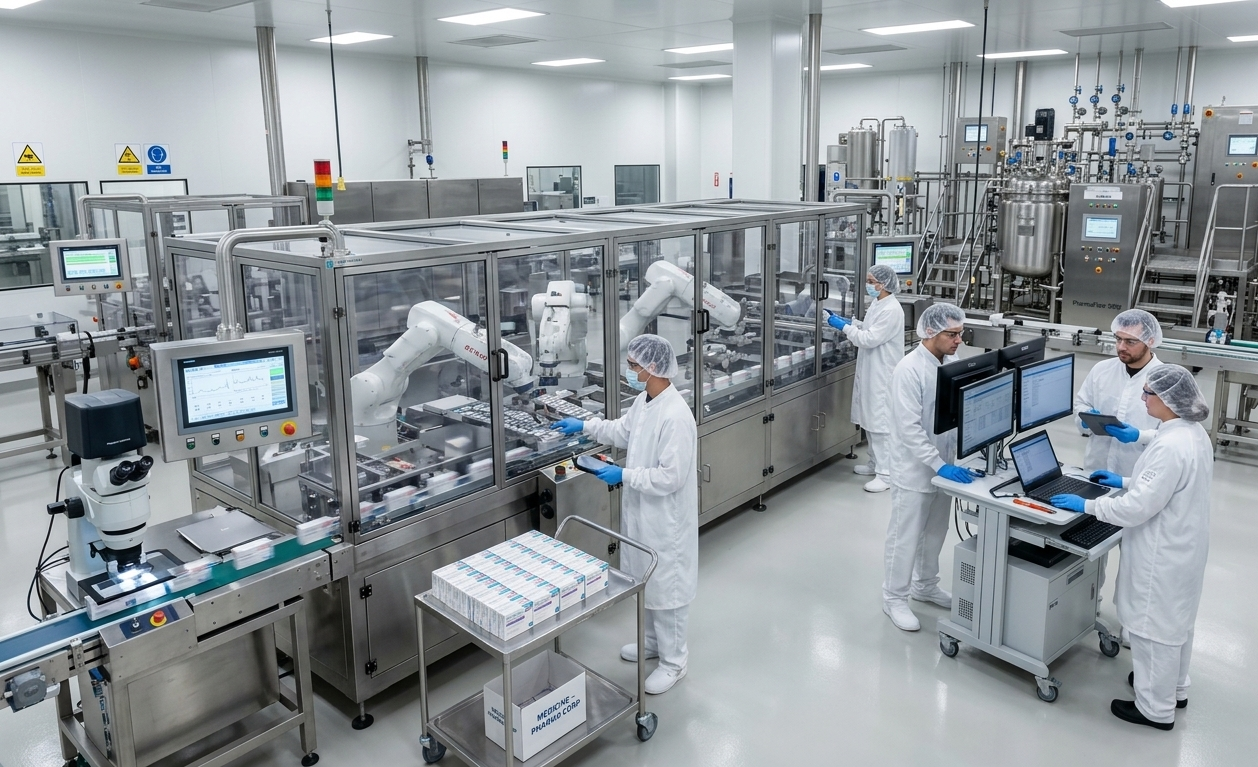
Discover how YuktraOS helps pharma manufacturers move beyond fragmented systems toward an intelligent, connected, and GxP-ready manufacturing environment.
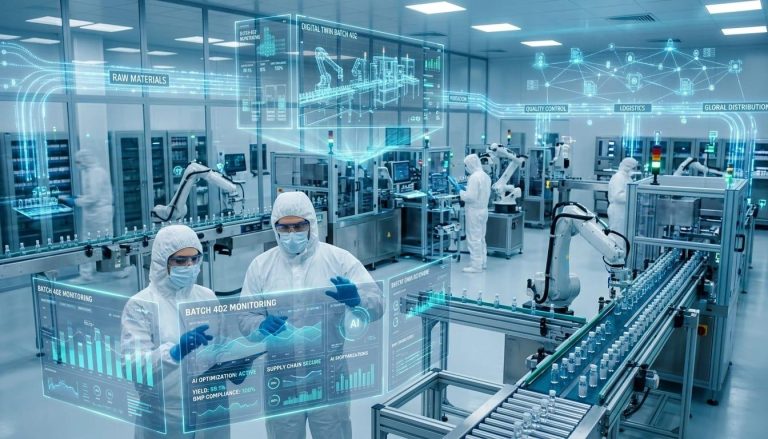
Pharmaceutical manufacturing is entering a new era where technology is no longer simply supporting operations. It is becoming central to how manufacturers manage quality, compliance, production, workforce knowledge, equipment, and business continuity. This shift is driving the growth of PharmaTech, where artificial intelligence, automation, connected systems, analytics, and digital workflows are being brought together to create smarter pharmaceutical manufacturing environments.
The urgency is also visible in the latest industry developments. In India, more than 960 risk-based inspections of pharmaceutical facilities have been conducted since the nationwide quality inspection campaign began, with enforcement action taken against approximately 860 facilities. The regulator has also stated that more than 99% of CDSCO processes have been digitized, while AI is being piloted for areas such as inspections, report generation, regulatory decisions, and safety evaluations.
At the same time, the global pharmaceutical industry is investing heavily in manufacturing capacity. Major pharmaceutical companies have announced more than $500 billion in U.S. investments covering manufacturing, research, and supply-chain expansion. The digital manufacturing opportunity is growing alongside these investments, with one recent industry estimate placing the global digital manufacturing market in life sciences at $41.65 billion in 2025, projected to reach $48.15 billion in 2026.
These developments point to a larger transformation. Pharma manufacturers are not simply looking for more software. They need technology that can connect their existing systems, operational knowledge, people, equipment, and compliance processes. This is where an intelligent operating system such as YuktraOS can make a meaningful difference.
See Contents
PharmaTech refers to the application of modern technologies to improve pharmaceutical research, manufacturing, quality management, compliance, workforce management, supply chains, and operational decision-making. It brings technologies such as artificial intelligence, machine learning, industrial IoT, automation, advanced analytics, cloud platforms, and intelligent knowledge systems into the pharmaceutical value chain.
However, PharmaTech should not simply mean adding another digital tool to an already complicated technology environment. A pharmaceutical manufacturing facility may already use an ERP for business operations, an MES for manufacturing, a QMS for quality, an LIMS for laboratory processes, and separate platforms for training, maintenance, documentation, and workforce management.
The challenge is that these systems often operate independently. Information exists, but employees may still struggle to find the right information when they need it.
For example, an operator facing an equipment problem may need to search through an equipment manual, locate the relevant SOP, speak with a supervisor, or wait for an experienced technician. A quality professional investigating a deviation may have to search through historical records, CAPAs, SOPs, and other documentation before identifying a similar incident.
This creates an important gap between having information and being able to use information effectively.
That gap is one of the biggest opportunities for PharmaTech.
Explore how Connected Manufacturing Intelligence can drive productivity, visibility, and business growth.
Modern pharmaceutical plants generate huge volumes of operational and compliance data. SOPs, equipment manuals, batch records, deviation reports, CAPAs, change controls, training documents, maintenance records, quality records, and production information are constantly being created and updated.
Yet, more information does not automatically result in better decision-making.
In many organizations, important knowledge remains distributed across different systems. Some knowledge also remains with experienced employees who understand how to handle specific situations because they have spent years working on the shop floor.
This creates what many organizations refer to as tribal knowledge.
When experienced employees retire, move to another organization, or change roles, a significant amount of practical knowledge can disappear with them. New employees then have to learn through observation, training, trial and error, or by repeatedly asking experienced colleagues.
This is where an intelligent PharmaTech platform can help transform knowledge into an accessible organizational asset.
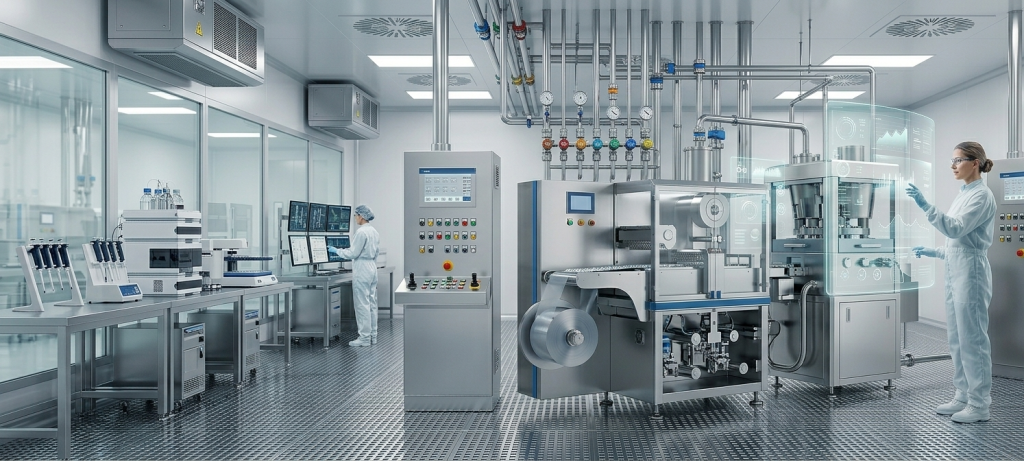
YuktraOS is designed specifically around the challenges of pharmaceutical manufacturing. It is mainly defined as: YuktraOS is an AI-powered, GxP-compliant operating system designed to bring knowledge, quality, equipment, workforce, and manufacturing intelligence together.
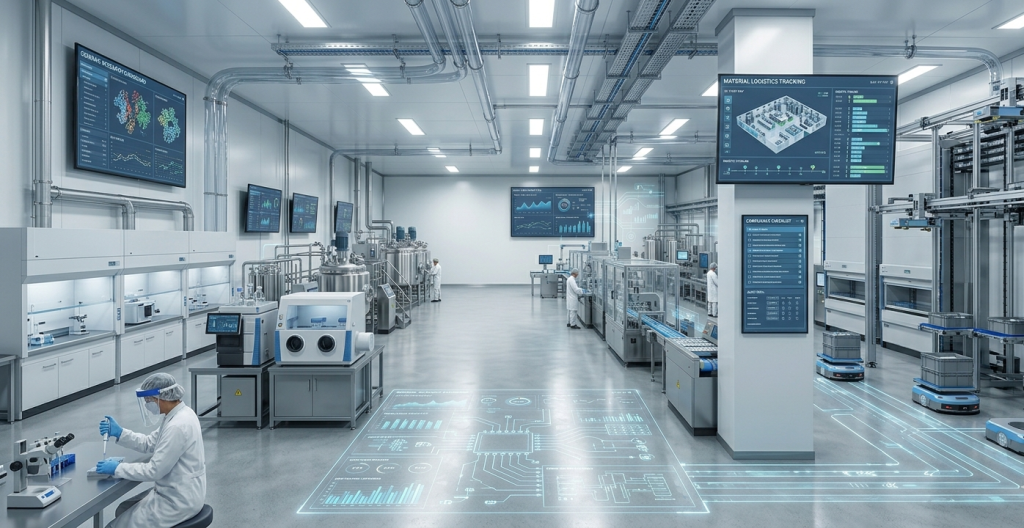
Rather than requiring pharmaceutical manufacturers to replace every existing system, YuktraOS is designed to work as an intelligence layer across the manufacturing environment.
The idea is simple but powerful. Existing systems continue performing their core functions, while YuktraOS helps employees access and use the knowledge contained across those environments.
This means a manufacturer can move from a fragmented software ecosystem toward a more connected and intelligent operating environment.
YuktraOS is designed to transform SOPs, OEM manuals, organizational knowledge, and operational information into accessible intelligence and guided workflows. This enables employees to interact with manufacturing knowledge through natural language, voice, and other intuitive methods.
SOPs are fundamental to pharmaceutical manufacturing. They define how processes should be performed, how equipment should be handled, and how employees should respond to specific situations.
However, a large library of SOPs can become difficult to navigate.
An employee may know that the answer exists somewhere in the documentation but may not know exactly where to find it. Searching through long documents can consume valuable time, especially during production or maintenance activities.
YuktraOS aims to make this knowledge more accessible by allowing employees to ask questions in natural language and receive responses based on approved organizational information.
Instead of treating an SOP as a static document, the platform helps turn it into actionable knowledge that employees can access during daily operations.
This can help manufacturers:
The objective is not to replace SOPs. It is to make them easier to use.
Experienced employees are often among the most valuable sources of manufacturing knowledge. They understand equipment behavior, recurring problems, historical deviations, troubleshooting techniques, and practical approaches that may not always be documented in detail.
YuktraOS is designed to help organizations capture and structure this knowledge so it becomes accessible beyond individual employees. Yuktra positions knowledge capture as an important part of reducing dependence on individual experts and making organizational intelligence reusable.
This can be particularly valuable when manufacturers are dealing with workforce changes, rapid expansion, or the onboarding of new employees.
Instead of asking, “Who knows how to solve this?”, employees can increasingly ask, “What does the organization know about this?”
That is a significant shift in manufacturing intelligence.
Compliance remains one of the most important priorities for pharmaceutical manufacturers. Regulatory expectations continue to evolve, while regulators are increasingly focused on quality systems, data integrity, documentation, and consistent manufacturing practices.
Recent regulatory activity in India demonstrates the importance of maintaining strong quality and compliance systems. More than 960 risk-based inspections have been conducted under India’s pharmaceutical quality campaign, with enforcement actions against approximately 860 facilities.
This makes continuous compliance more important than simply preparing for an inspection.
YuktraOS is designed for regulated pharmaceutical environments and supports compliance requirements around areas such as GxP, 21 CFR Part 11, EU GMP Annex 11, and GAMP 5. The platform is also designed around features such as audit trails, version control, traceability, and electronic signatures.
The broader objective is to make compliance part of everyday execution rather than treating it as a separate activity.
Deviation management can consume substantial time for quality teams. Investigators often need to review previous incidents, compare historical cases, identify potential root causes, examine SOPs, and determine appropriate corrective and preventive actions.
An intelligent system can help bring relevant information together.
YuktraOS includes quality management capabilities designed around areas such as deviations, CAPA, change controls, and related quality processes.
By making historical knowledge more accessible, the platform can help quality teams identify patterns and relevant precedents more efficiently.
The goal is not to allow AI to make uncontrolled quality decisions. Instead, it is to provide quality professionals with better context and faster access to information so they can make informed decisions.
Equipment is at the heart of pharmaceutical manufacturing. When equipment stops working correctly, the consequences can extend beyond maintenance.
Production schedules can be affected. Batch timelines can shift. Operators may need assistance. Quality teams may need to investigate potential impacts.
Equipment manuals often contain the information needed to address these situations, but those manuals can be extensive and difficult to navigate quickly.
YuktraOS brings equipment intelligence into the manufacturing environment, helping employees access information from OEM manuals and equipment-related knowledge.
This can support:
By making equipment knowledge easier to access, PharmaTech can connect human expertise with machine intelligence.
Pharmaceutical manufacturing facilities often employ people with different language backgrounds. This can create challenges when technology, documentation, and training are primarily designed around one language.
YuktraOS supports multilingual interactions, including voice and text-based access to information across multiple languages. This can help make operational knowledge more accessible to a wider manufacturing workforce.
This is important because technology adoption depends heavily on usability.
A highly sophisticated platform will not create meaningful value if employees struggle to interact with it. Multilingual and conversational access can make AI more practical for real-world manufacturing environments.
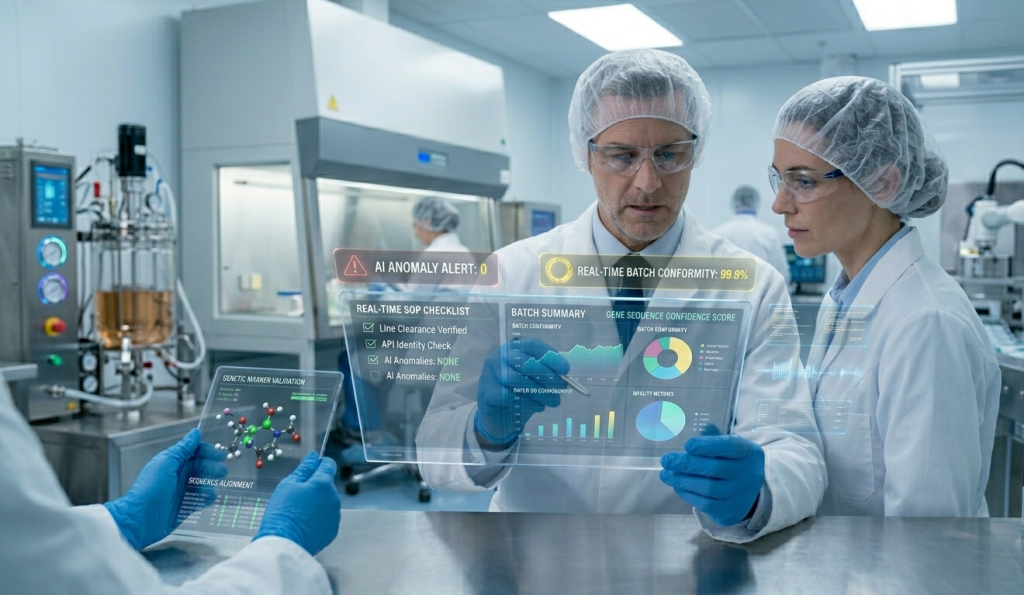
One of the strongest arguments for YuktraOS is that pharmaceutical manufacturers do not need another isolated application.
They need an intelligence layer that can work across the existing technology environment.
YuktraOS brings together multiple capabilities, including:
This modular approach recognizes an important reality: pharmaceutical manufacturing is not one process.
Quality, production, maintenance, training, compliance, and equipment performance are deeply connected. Improving one area can influence another.
An intelligent operating system can help connect those relationships.
The pharmaceutical industry is facing increasing pressure to improve quality while maintaining efficiency.
Manufacturers must deal with tighter regulatory expectations, complex supply chains, workforce challenges, increasing production requirements, and the need for greater operational resilience.
India’s pharmaceutical industry alone was valued at approximately $60 billion as of March 2026, with exports accounting for around $31 billion and domestic sales around $29 billion, according to recent industry reporting.
At the same time, global pharmaceutical companies are investing hundreds of billions of dollars in new manufacturing capacity and supply-chain infrastructure.
As manufacturing footprints expand, the need for scalable operational intelligence becomes even more important.
A new manufacturing facility does not only need more machines. It needs better access to knowledge. It needs stronger workforce enablement. Also, it needs continuous compliance. Moreover, it needs faster decision-making. And it needs technology that can scale alongside the organization.
This is why PharmaTech is moving from experimentation toward execution.
Explore how Connected Manufacturing Intelligence can drive productivity, visibility, and business growth.
One misconception about AI in pharmaceutical manufacturing is that the technology needs to replace human workers.
The more practical approach is to use AI to make human workers more capable. A QA professional should still make critical quality decisions. An operator should still be responsible for executing approved procedures. A plant manager should still oversee production. A maintenance engineer should still evaluate equipment issues. AI can support these professionals by making the right information available at the right time.
This human-plus-AI model is particularly important in regulated industries because pharmaceutical manufacturing requires accountability, validation, traceability, and controlled decision-making.
The International Federation of Pharmaceutical Manufacturers and Associations has also highlighted the growing importance of AI applications in pharmaceutical manufacturing and the need to consider regulatory expectations when AI is used in manufacturing and control processes.
Therefore, the future is not about blindly automating every decision.
It is about creating an intelligent environment where people can make better decisions with better information.
The pharmaceutical manufacturing industry has already invested heavily in digital technologies. ERP, MES, QMS, LIMS, automation, analytics, and other systems have become important components of modern manufacturing environments.
But the next stage of transformation will require something more.
Manufacturers need to connect their systems, knowledge, people, equipment, and processes through an intelligent layer.
That is where YuktraOS can become an important part of the PharmaTech strategy.
YuktraOS is designed to help pharmaceutical manufacturers turn scattered information into accessible intelligence, transform static documentation into usable knowledge, preserve tribal knowledge, support quality processes, improve equipment intelligence, strengthen workforce enablement, and build a more connected manufacturing environment.
The future pharmaceutical plant will not simply be digital.
It will be intelligent, connected, contextual, and continuously learning.
And for manufacturers looking to prepare for that future, the question is no longer whether PharmaTech matters.
The real question is how quickly they can turn PharmaTech into measurable operational value.
YuktraOS is built to help make that transition possible.
If your pharmaceutical manufacturing organization is looking to improve operational intelligence, compliance, workforce productivity, and access to manufacturing knowledge, explore YuktraOS and connect with the Yuktra team to understand how an AI-powered operating system can fit into your manufacturing environment.