PharmaTech in 2026: Why Pharma Manufacturing Needs an AI-Powered Operating System
Discover how YuktraOS helps pharma manufacturers move beyond fragmented systems…
Read More
Discover the latest pharmaceutical AI market statistics, growth trends, and research driving the future of smarter pharmaceutical manufacturing.
See Contents
Pharmaceutical AI is rapidly becoming one of the biggest drivers of innovation in pharmaceutical manufacturing. From predictive maintenance and intelligent quality management to regulatory compliance and production optimization, artificial intelligence is helping manufacturers improve efficiency while maintaining strict compliance standards. Recent market research shows that investments in pharmaceutical AI are growing significantly as companies look to reduce costs, improve product quality, and accelerate digital transformation. As global competition intensifies, pharmaceutical manufacturers are increasingly adopting AI technologies to build smarter, more connected, and future-ready manufacturing operations.
Discover how Yuktra helps pharmaceutical manufacturers improve compliance,
reduce downtime, optimize production, and make smarter decisions with
enterprise-grade AI built for regulated environments.
The market for AI in the pharmaceutical industry has experienced remarkable growth over the past few years. According to Grand View Research, the global AI in pharmaceuticals market was valued at approximately USD 1.8 billion in 2024 and is expected to grow at a compound annual growth rate (CAGR) of more than 28% through the next decade. This impressive growth reflects the increasing confidence that pharmaceutical companies have in AI-powered technologies. Companies are expanding AI investments across manufacturing, quality assurance, supply chain management, laboratory operations, and regulatory compliance to improve productivity and remain competitive.
Although artificial intelligence initially gained attention for drug discovery, manufacturing has become one of the fastest-growing applications. According to MarketsandMarkets, the global AI in manufacturing market is expected to surpass USD 20 billion within the next few years. Pharmaceutical manufacturers are among the leading contributors to this growth because they operate in highly regulated environments where process optimization and quality control are essential. AI enables manufacturers to monitor production in real time, detect abnormalities before they become failures, and improve Overall Equipment Effectiveness (OEE) across manufacturing facilities.
Digital transformation continues to be a strategic priority across the pharmaceutical industry. Deloitte’s Global Life Sciences Outlook reports that pharmaceutical companies are significantly increasing technology investments to modernize manufacturing operations. AI projects are receiving a substantial share of these budgets because organizations recognize their potential to automate repetitive tasks, improve decision-making, and strengthen compliance. Rather than deploying isolated AI solutions, many companies are building enterprise-wide AI platforms that connect quality, manufacturing, maintenance, engineering, and regulatory functions into a unified ecosystem.
One of the strongest use cases for pharmaceutical AI is predictive maintenance. Manufacturing equipment continuously generates operational data that can be analyzed using machine learning models. According to McKinsey & Company, predictive maintenance can reduce maintenance costs by 10% to 40% while decreasing equipment downtime by 30% to 50%. For pharmaceutical manufacturers, these improvements directly translate into higher production availability, fewer unexpected shutdowns, and more reliable manufacturing schedules. As a result, predictive maintenance is becoming a standard component of modern pharmaceutical manufacturing strategies.
Quality management remains one of the most resource-intensive functions in pharmaceutical manufacturing. Manufacturers must manage deviations, CAPAs, change controls, investigations, audits, and extensive documentation while complying with FDA, WHO GMP, EU GMP, and GxP regulations. AI simplifies these activities by automatically retrieving relevant documents, identifying compliance gaps, analyzing historical quality events, and supporting faster root cause investigations. This allows quality teams to spend less time searching for information and more time resolving critical manufacturing issues.
Generative AI is creating new opportunities inside pharmaceutical manufacturing facilities. Instead of manually searching through hundreds of Standard Operating Procedures (SOPs), operators can ask AI assistants questions in natural language and receive validated answers instantly. AI-powered knowledge assistants help employees access equipment manuals, batch records, validation documents, and regulatory guidelines within seconds. This capability improves workforce productivity, accelerates employee onboarding, and reduces the risk of human error during manufacturing operations.
Global investment trends indicate that AI adoption will continue accelerating across manufacturing industries. According to PwC, artificial intelligence could contribute USD 15.7 trillion to the global economy by 2030. Manufacturing is expected to capture a significant share of this economic value due to increased automation, improved productivity, and data-driven decision-making. IBM’s Global AI Adoption Index also reports that manufacturing organizations remain among the leading industries adopting AI technologies, with operational efficiency being one of the primary investment drivers.
Modern pharmaceutical facilities generate enormous volumes of production, quality, maintenance, and operational data every day. AI enables manufacturers to convert this information into actionable insights. Instead of relying solely on historical reports, organizations can monitor manufacturing performance in real time, identify production bottlenecks, forecast equipment failures, optimize batch execution, and improve production scheduling. This shift toward operational intelligence allows companies to make faster and more informed decisions while maintaining regulatory compliance.
Several industry challenges are driving the rapid adoption of AI across pharmaceutical manufacturing. Increasing regulatory complexity requires organizations to maintain accurate documentation and complete audit readiness. Rising production costs are encouraging manufacturers to optimize resource utilization and reduce waste. Workforce shortages and the retirement of experienced employees have increased the demand for AI-powered knowledge management systems that preserve organizational expertise. At the same time, growing expectations for product quality and faster production cycles have made intelligent automation an essential competitive advantage.
Despite the impressive market growth, AI implementation still presents several challenges. Many pharmaceutical manufacturers operate legacy systems that make integration difficult. Data quality remains a critical factor because AI models require standardized and accurate manufacturing data to deliver reliable results. Regulatory validation is another important consideration, as AI systems must comply with industry standards and maintain complete transparency for inspections. Successful AI adoption therefore requires a combination of strong governance, validated data, secure deployment, and effective change management.
AI adoption is accelerating across pharmaceutical manufacturing. Stay ahead with
Yuktra’s AI-powered platform designed to simplify compliance, strengthen quality
management, improve manufacturing efficiency, and empower your workforce with
intelligent decision support.
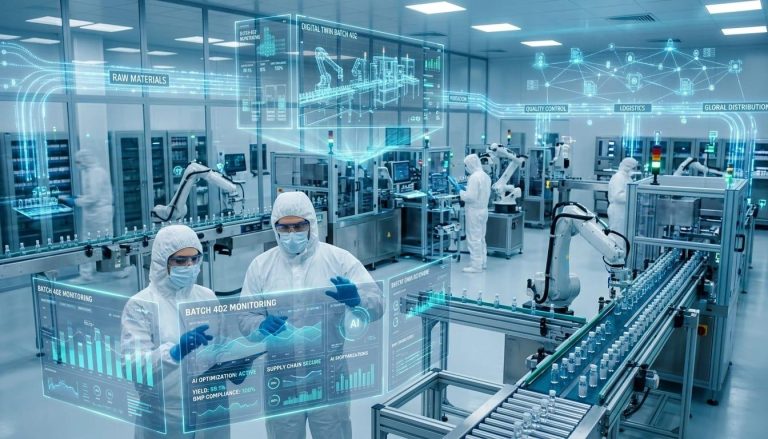
Industry research consistently indicates that AI adoption will continue to expand throughout the pharmaceutical manufacturing sector over the coming years. Future innovations are expected to include AI-assisted batch release, autonomous production optimization, digital twins, intelligent quality management systems, predictive compliance monitoring, and enterprise-wide knowledge assistants. Manufacturers that invest early in scalable AI platforms will be better positioned to improve operational efficiency, reduce compliance risks, and respond more effectively to changing market demands.
Read the details of the Best pharma software.
The latest market research clearly shows that pharmaceutical AI is transforming pharmaceutical manufacturing at an unprecedented pace. Strong market growth, increasing technology investments, and measurable operational benefits demonstrate that AI is no longer an experimental technology but a strategic business capability. Organizations that successfully implement pharmaceutical AI across manufacturing, quality, maintenance, compliance, and workforce operations will be better equipped to improve productivity, reduce operational costs, maintain regulatory compliance, and achieve long-term competitive advantage in an increasingly digital pharmaceutical industry.