PharmaTech in 2026: Why Pharma Manufacturing Needs an AI-Powered Operating System
Discover how YuktraOS helps pharma manufacturers move beyond fragmented systems…
Read More
Without real-time shop floor visibility, pharma plants react to problems instead of preventing them. Discover what’s holding them back.
Also And why the ones that do are pulling ahead — fast.
There is a question that makes most pharma plant heads uncomfortable.
Not because it is complicated. Because the answer is obvious, and the implications are expensive.
The question is this: Right now, at this moment, do you know exactly what is happening on your shop floor?
Not what happened this morning. Not what the shift report will say at 6 PM. Right now, which batch is running, where it stands, whether any parameter has drifted, whether the operator executing that step has been trained on the latest SOP revision, and whether there is a deviation sitting unlogged because nobody has had time to open the system yet.
If the answer requires you to call someone, wait for a message, or check a report that was compiled an hour ago, you do not have shop floor visibility.
You have shop floor history.
And in a regulated pharma manufacturing environment, the difference between the two is not a matter of convenience. It is the difference between controlling your process and reacting to it.
See Contents
Most pharma plants operate with a quiet, accepted fiction: that the information flowing through WhatsApp groups, morning MIS reports, and supervisor walkthroughs constitutes operational visibility.
It does not.
What it constitutes is a reconstruction, a picture assembled after the fact, from fragments, by people who are also busy managing the very operations they are supposed to be reporting on. By the time that picture reaches a plant head or operations manager, it is already historical. The decisions being made based on it concern a plant that no longer exists in that state.
This is not a criticism of the people involved. It is a structural problem. And it is almost universal across pharma MSMEs in India.
The question is: why has it persisted for so long?
Walk into almost any pharma manufacturing plant in India, and you will find Excel at the centre of operations. Batch records, deviation logs, training matrices, equipment calibration schedules, SOP version control, all of it living in spreadsheets, across shared drives, on individual laptops, in formats that differ from one department to the next.
Excel is a brilliant tool. For analysing data that already exists. For building models. Also, for financial planning.
It is a terrible tool for real-time operational management.
A spreadsheet cannot tell you when a parameter goes out of range. It cannot alert you when a batch crosses a critical step without a trained operator present. Also, cannot flag that the SOP being followed on Line 3 is version 4.1 when version 4.2 was approved six weeks ago. It cannot do any of this because it is passive, it waits to be filled in, not to inform.
The moment you are dependent on Excel for shop floor visibility, you have already introduced a delay. Someone has to observe the event, decide it is worth recording, open the file, find the right sheet, and enter the data. In a busy production environment, that sequence often takes hours. Sometimes it does not happen at all until the end of the shift.
By which point, the problem has either resolved itself or become significantly worse.
This one is sensitive because WhatsApp has genuinely made plant communication faster. Messages go out instantly. Photos of deviations can be shared. Supervisors can coordinate across zones without walking the floor.
But WhatsApp is a conversation tool, not a compliance tool. And somewhere along the way, pharma plants started treating it as both.
Think about what lives in your plant’s WhatsApp groups right now. Deviation reports sent as voice notes. Equipment breakdown alerts that never made it into your CAPA system. Training confirmations are exchanged as text messages that disappear after sixty days. Decisions made and acknowledged in chat threads that have no audit trail, no version control, and no link to the batch record they affected.
Every one of those messages is operational intelligence that exists nowhere else. It cannot be searched. It cannot be analysed. Also, it cannot be produced during an audit. And it is almost certainly not being captured in your QMS.
The real danger of WhatsApp dependency is not that it is slow; it is that it creates a parallel operational record that is completely invisible to your quality systems. You think you are communicating. You are actually creating undocumented decisions.

The standard operational reporting cycle in most pharma plants works like this: operators record data during or after a shift, supervisors compile and verify, MIS teams aggregate and format, and reports reach management by the following morning at the earliest, often later.
This cycle exists because it is how plants have always worked. Paper-based records required it. Legacy systems reinforced it. And organisations built their management rhythms around it.
The problem is that the pharma operating environment has changed dramatically. Revised Schedule M mandates real-time electronic batch records. FDA expects data integrity and immediate traceability. Regulatory expectations around ALCOA+ — attributable, legible, contemporaneous, original, accurate- are not compatible with a reporting cycle that runs eighteen hours behind reality.
When a regulator asks you to demonstrate that a specific parameter was within specification at a specific time during a specific batch, “I will have the report by tomorrow morning” is not an acceptable answer.
Delayed reporting is not just an operational inconvenience. In a regulated environment, it is a compliance exposure.
Ask a plant head where to find the current status of open deviations, equipment availability, batch progress, and training compliance for their plant, all in one place, in real time.
Most cannot answer that question.
Not because the information does not exist. It does — spread across a QMS that is updated weekly, an Excel tracker that lives on a Quality executive’s laptop, a CMMS module that the maintenance team uses inconsistently, and a training register that HR maintains separately from operations.
Each of these systems knows a piece of the story. None of them know the whole story. And there is no layer that connects them.
The result is what management consultants call information silos — but in a pharma plant, the consequences are more serious than in most industries. When your Quality team does not know that the equipment your operator is using has a pending calibration overdue, and your operator does not know that the SOP they are following has been updated, and your plant head does not know that three deviations from the same line have been logged in the past week — these are not information gaps. They are systemic risk factors.
Centralised operational intelligence is not a luxury. In a regulated manufacturing environment, it is the foundation of sustainable compliance.
Here is the most uncomfortable truth in this entire article.
When plants operate without real-time visibility, they cannot be proactive. The information required to anticipate problems, trending data, early deviation signals, training compliance rates, and equipment performance patterns either does not exist in an accessible form or arrives too late to act on.
So management becomes reactive. Problems are managed after they occur. Deviations are investigated after the batch has been released or rejected. Audit preparedness becomes a sprint every time an inspector is expected rather than a permanent state.
This is not incompetence. It is an adaptation. Smart, experienced plant managers have developed sophisticated instincts for reading their operations — knowing which supervisors to call, which lines to watch, which signals tend to precede problems. That institutional knowledge is genuinely valuable.
But it is not a system. It is a person. And it does not scale, transfer, or survive attrition.
When your most experienced plant manager leaves, they take their visibility with them.
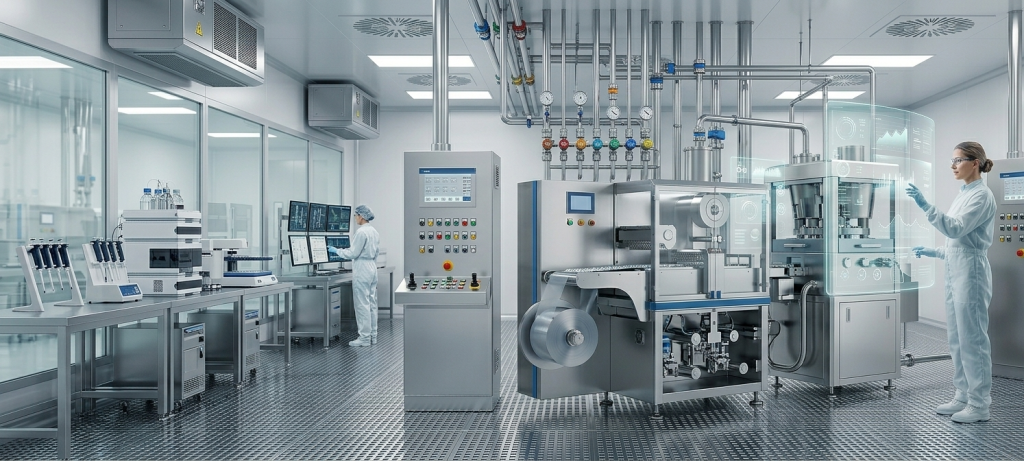
Real-time shop floor visibility is not a dashboard. It is not a report that refreshes every fifteen minutes. It is not a system that your IT team installs, and your operations team works around.
Also, it is the ability of every person in your plant, from the operator on the line to the plant head in their office- to access the right information, in the right form, at the moment they need it.
For an operator, that means knowing the exact procedure for the step they are executing right now, not a printed SOP from six months ago, but the current approved version, in Hindi if that is what they read best, with the specific context relevant to the equipment in front of them.
Moreover, for a supervisor, it means knowing in real time whether every step of an ongoing batch has been executed correctly, whether any parameter has drifted, and whether the people on their line have been trained for their tasks.
For a quality manager, it means never walking into an audit uncertain about whether documentation is complete, whether deviations are closed, or whether CAPA actions have been verified.
Moreover, for a plant head, it means having a single view of operational health across every line, every batch, every compliance indicator, not because someone compiled it for them, but because the system maintains it continuously.
This is not a vision. Plants that have implemented the right digital infrastructure are operating this way today.
There is an external force that is making this conversation urgent in a way that it was not two years ago.
Revised Schedule M is now in effect for Indian pharma manufacturers. Among its requirements: electronic batch manufacturing records, real-time data integrity, and audit trail mechanisms that meet the standard of 21 CFR Part 11 equivalence.
These are not aspirational guidelines. They are compliance requirements.
And here is the uncomfortable reality: a plant that is still running on Excel, WhatsApp, and delayed reporting is not just operationally disadvantaged. It is non-compliant with current regulatory expectations.
The plants that invested in operational visibility infrastructure before the deadline are entering 2025 with audit readiness as a permanent state. The plants that did not are facing a remediation exercise under regulatory pressure, which is always more expensive, more disruptive, and less effective than building the right systems proactively.
Before the next shift begins, before the next batch is released, before the next audit notice arrives — ask this honestly:
If a regulator walked onto your floor right now and asked to see the current status of your ongoing batches, the training records for the operators handling them, the open deviations related to the equipment they are using, and the last three CAPA actions closed on that line, how long would it take you to produce that information?
If the answer is anything other than “immediately,” you have a visibility problem.
The good news is that this is a solvable problem. The tools exist. The methodology is proven. And the window to solve it proactively, rather than reactively, is still open.
There is a phrase that circulates in pharma manufacturing circles: “We are compliant, we have never had a major observation.”
It is meant as reassurance. Increasingly, it functions as a warning sign.
Not having been caught is not the same as not having a risk. And the plants that are building real-time visibility are not doing it because a regulator told them to. They are doing it because they have understood something important:
In pharma manufacturing, information that arrives after the problem is not intelligence. It is a post-mortem.
The shift from reactive to real-time is not a technology decision. It is a leadership decision about what kind of organisation you intend to run.
YuktraOS is an AI-powered operating system built specifically for pharma manufacturing MSMEs, connecting SOPs, equipment, training, and quality management into a single, real-time intelligence layer for your plant floor.
To see how YuktraOS creates real-time shop floor visibility in a 20-minute live demonstration, contact us at gxp@yuktra.ai or visit www.yuktra.ai.