Why Should You Implement AI in Your Pharma Plant in 2026?
earn why pharmaceutical manufacturers are choosing to implement AI in…
Read More
Explore the use of artificial intelligence in pharma manufacturing, including benefits, use cases, stakeholders, and future trends, where the use of artificial intelligence in pharma manufacturing is transforming quality, efficiency, and compliance across the industry.
See Contents
The use of artificial intelligence in pharma manufacturing is no longer a futuristic concept. It is already reshaping how drugs are developed, produced, and delivered to patients. The industry is witnessing rapid transformation, backed by strong data and measurable outcomes.
According to a 2026 market research report, the global AI in pharma manufacturing market is expected to grow from $1.2 billion to $34.7 billion by 2040, at a CAGR of around 28%. Another report highlights that AI can potentially generate nearly $100 billion annually in value across the healthcare ecosystem. Additionally, AI-driven processes have reduced drug development timelines from 5-6 years to nearly 1 year in some cases.
These numbers are not just impressive. They signal a deep structural shift in how pharmaceutical manufacturing operates.
Discover how artificial intelligence can transform your manufacturing operations with better efficiency, quality, and compliance.
Before diving into the use of artificial intelligence, it is important to understand the key stakeholders in pharmaceutical manufacturing. Each of these stakeholders plays a critical role, and AI is influencing all of them in different ways.
R&D is the starting point of drug creation. Scientists and researchers work on identifying compounds, testing efficacy, and designing formulations. This stage is time-intensive and expensive, often taking over a decade for a single drug.
These teams are responsible for scaling up production while maintaining strict quality and regulatory compliance. Even minor deviations can lead to batch failures, costing millions.
QA and QC ensure that every product meets regulatory standards. Pharma manufacturing operates under strict frameworks like GMP (Good Manufacturing Practices), making compliance non-negotiable.
Organizations such as the FDA and EMA enforce compliance. They require traceability, documentation, and validation at every stage of production.
Pharma supply chains are complex, involving temperature-sensitive logistics, global distribution networks, and demand forecasting.
Ultimately, the success of pharma manufacturing is measured by patient outcomes. Speed, quality, and accessibility all impact end users.
The use of artificial intelligence connects all these stakeholders into a more efficient, data-driven ecosystem.
The pharmaceutical industry has traditionally relied on manual processes, legacy systems, and human expertise. However, increasing complexity, regulatory pressure, and demand for faster drug delivery have made this model unsustainable.
The use of artificial intelligence enables companies to:
AI is now embedded across the entire pharma value chain, from molecule discovery to final product delivery.
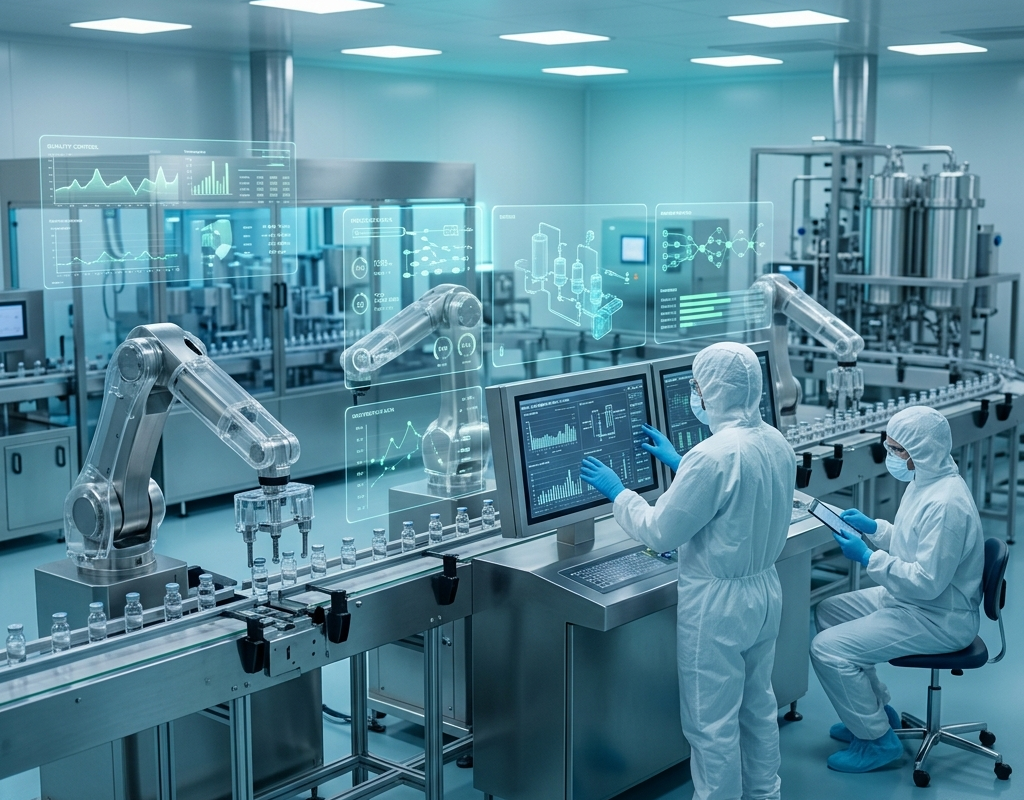
One of the most impactful areas of the use of artificial intelligence is predictive maintenance.
AI systems analyze machine data from sensors to detect early signs of failure. Instead of reacting to breakdowns, manufacturers can prevent them.
Impact:
This ensures continuous production, which is critical in pharma manufacturing where delays can affect patient access to medicines.
Maintaining consistent product quality is one of the biggest challenges in pharma manufacturing.
The use of artificial intelligence allows real-time monitoring of production parameters. AI models analyze data from sensors, cameras, and analytical instruments to detect anomalies instantly.
Impact:
AI-driven quality systems help ensure that drugs meet strict regulatory standards without delays.
Pharmaceutical manufacturing involves complex chemical and biological processes.
The use of artificial intelligence helps optimize these processes by identifying patterns in historical and real-time data. AI can recommend optimal parameters for temperature, pressure, and chemical composition.
Impact:
According to industry insights, AI enables manufacturers to produce more saleable products by minimizing process variability.
Traditionally, drug development and manufacturing were separate processes. This often led to challenges during scale-up.
The use of artificial intelligence bridges this gap by integrating manufacturing considerations early in the development phase.
Impact:
AI enables a “design for manufacturing” approach, which is critical in today’s competitive pharma landscape.
Pharma supply chains are highly complex and sensitive to disruptions.
The use of artificial intelligence improves demand forecasting, inventory management, and logistics planning.
Impact:
AI-driven supply chains are more resilient and responsive, especially during global crises like pandemics.
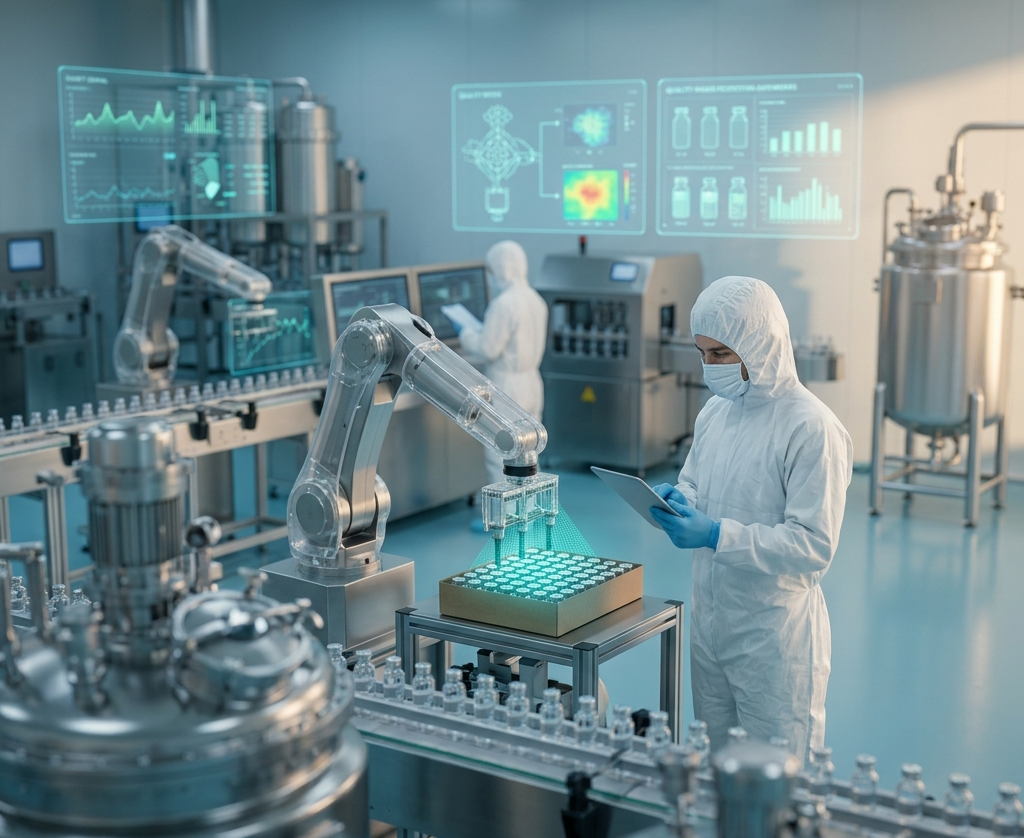
Compliance is one of the most critical aspects of pharma manufacturing.
The use of artificial intelligence automates documentation, ensures traceability, and helps maintain audit-ready systems.
Impact:
However, it is important to note that AI must be used with proper human oversight to avoid regulatory issues.
AI-powered robotics are transforming production lines.
The use of artificial intelligence enables robots to perform tasks such as:
Impact:
Automation is particularly useful in sterile environments where contamination risks must be minimized.
The rise of personalized medicine requires flexible manufacturing systems.
The use of artificial intelligence enables manufacturers to produce smaller, customized batches efficiently.
Impact:
This marks a shift from mass production to patient-centric manufacturing.
Leverage the use of artificial intelligence to optimize production, reduce costs, and improve compliance outcomes.
The adoption of AI brings several measurable benefits:
Despite its advantages, the use of artificial intelligence in pharma manufacturing comes with challenges:
The future of artificial intelligence in pharma manufacturing looks promising.
We are moving towards Pharma 4.0, where fully connected, intelligent systems drive operations. AI will continue to evolve in areas such as:
Major pharmaceutical companies are already integrating AI into their operations to stay competitive.
In the coming years, AI will not replace humans but will augment their capabilities, enabling smarter and faster decision-making.
The use of artificial intelligence in pharma manufacturing is transforming the industry at every level. From predictive maintenance to personalized medicine, AI is enabling faster, safer, and more efficient production processes.
As the industry continues to evolve, companies that embrace AI will gain a significant competitive advantage. Those who delay adoption risk falling behind in a rapidly changing landscape.
The future of pharma manufacturing is intelligent, connected, and driven by data. And at the center of it lies the growing use of artificial intelligence.
The use of artificial intelligence in pharma manufacturing refers to the application of advanced algorithms such as machine learning, deep learning, and computer vision to improve how medicines are produced, tested, and delivered. AI helps manufacturers optimize production processes, reduce human error, maintain regulatory compliance, and improve overall product quality. It is increasingly becoming a core part of modern Pharma 4.0 initiatives, where data-driven decision-making replaces traditional manual monitoring and reactive problem-solving.
AI is used across the entire pharma manufacturing lifecycle. In production, it supports real-time monitoring of equipment and environmental conditions. In maintenance, it enables predictive alerts before machine failures occur. Moreover, for quality control, AI-powered vision systems detect defects that may not be visible to the human eye. It is also used in supply chain planning, demand forecasting, and batch optimization. Overall, AI brings intelligence into every step of manufacturing, making processes more efficient, consistent, and reliable.
The benefits of the use of artificial intelligence in pharma manufacturing are significant and measurable. It improves operational efficiency by reducing downtime and optimizing resource usage. It enhances product quality by ensuring consistent monitoring and early detection of deviations. Also, it reduces manufacturing costs by minimizing waste and improving yield. It also shortens production cycles and improves compliance readiness, which is critical in highly regulated environments. Together, these benefits help pharma companies achieve faster and safer delivery of medicines.
Yes, AI plays a critical role in improving drug quality. It continuously analyzes production data in real time to detect even minor deviations in temperature, pressure, or chemical composition. AI systems can identify patterns that indicate potential quality risks before they become serious issues. This ensures that every batch meets strict regulatory standards. As a result, manufacturers achieve higher consistency, fewer rejected batches, and better overall product reliability.
Despite its advantages, implementing AI comes with challenges. One of the biggest issues is poor data quality or fragmented data systems that limit AI accuracy. Many organizations also struggle with integrating AI into legacy manufacturing systems. Regulatory compliance adds another layer of complexity because AI decisions must be transparent and explainable. Additionally, there is a shortage of professionals who understand both pharmaceutical processes and AI technologies, which slows down adoption.
AI simplifies regulatory compliance by automating documentation, ensuring complete traceability of manufacturing data, and maintaining digital audit trails. It helps companies stay aligned with guidelines such as GMP by continuously monitoring process parameters and flagging deviations in real time. AI also supports faster audit preparation by organizing data in structured formats that regulators can easily review. This reduces compliance risks and improves readiness for inspections.
The future of the use of artificial intelligence in pharma manufacturing is moving toward fully autonomous and intelligent production systems. We will see increased adoption of digital twins, where virtual models simulate manufacturing processes before actual production. AI will also enable real-time release testing, reducing delays in product distribution. Additionally, personalized medicine manufacturing will become more scalable with AI-driven flexible production systems that can handle small, customized batches efficiently.
No, AI is not replacing humans in pharma manufacturing. Instead, it is enhancing human capabilities by handling repetitive, data-heavy, and time-consuming tasks. Humans remain essential for decision-making, validation, and regulatory oversight. AI acts as an assistant that improves speed, accuracy, and efficiency, while human expertise ensures safety, ethics, and compliance in critical manufacturing environments.
Yuktra is an AI-powered structured intelligence platform designed for regulated manufacturing environments such as pharma. It helps organizations bring together SOPs, compliance documentation, training content, and operational knowledge into a single unified system. Instead of relying on scattered documents or manual searches, users can access critical information instantly in their workflow.
In pharma manufacturing, Yuktra supports operators, quality teams, and managers by delivering real-time guidance on processes, compliance checklists, and standard operating procedures. It also enables multilingual support, which is important for global and diverse manufacturing teams. This reduces dependency on memory-based execution and improves consistency in operations.
Find more details on Compliance in Pharma.
Within the broader use of artificial intelligence in pharma manufacturing, Yuktra represents the shift from AI as an analytical tool to AI as an operational assistant. It helps organizations not only analyze data but also execute processes correctly, improving compliance, reducing errors, and accelerating decision-making at the shop-floor level.
See how the use of artificial intelligence in pharma manufacturing is shaping the future of intelligent production systems.
AI significantly improves efficiency and productivity by automating repetitive tasks, optimizing production schedules, and reducing machine downtime. It enables better resource allocation by predicting demand and adjusting production accordingly. AI-driven systems also reduce manual intervention in monitoring and reporting, allowing teams to focus on higher-value activities. Over time, this leads to faster production cycles, higher output quality, and more efficient use of manufacturing resources, making operations more agile and competitive.